Broad portfolio for process valve automation
Do you need single components to automate process valves, or a complete, standards-compliant and repeatable automation package? Choose the approach that fits your design. Our pneumatic expertise, wide product range and practical engineering support will help you to specify products faster, integrate them smoothly and keep documentation consistent across multi-vendor configurations.
It’s your choice: on/off valves or flow control valves
For on/off valves, sensor boxes/limit switches provide reliable electrical feedback and position monitoring. For flow control, digital electro-pneumatic positioners deliver accurate performance and are easy to commissioning.
Rotary or linear motion: choose the right actuator for your application
Linear actuators are suitable for air damper control, bulk material handling and regulating flow and fill levels. Quarter-turn actuator options, including pneumatic rotary actuator variants, are ideal for ball, shut-off, and butterfly valves in demanding process environments.
Whatever you decide, standardised architectures, broad component coverage and selection support help reduce effort and complexity. You also shorten time-to-delivery with fewer redesign loops.
Your benefits:
- Reduced engineering and documentation workload
- A reliable second source for key automation components
- Standardised yet flexible architectures across brands
- Commercially viable solutions that scale across industries
Explore components for process valve automation
Rotary actuators for precise rotary motion and high torque performance
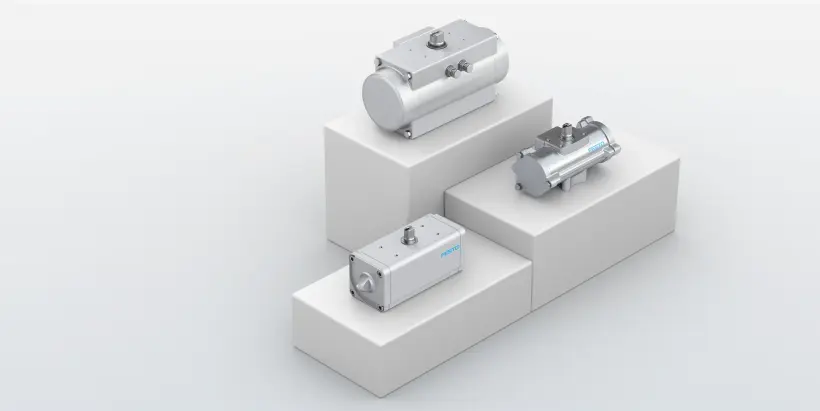
Quarter-turn actuators DFPD are available as standalone or as part of a complete automated process valve system. The swivel direction can be configured to the left or right in order to set Fail Open or Fail Close in single-acting designs. The ISO 5211 valve interface plus NAMUR mounting make it easier to fit solenoid valves, sensors and positioners. Nickel-plated or stainless shafts add durability, while the pilot-valve re-breather function helps protect the springs in corrosive atmospheres. Options include standard, epoxy-coated and anodised aluminium housings.
Linear actuators for accurate linear motion and positioning control
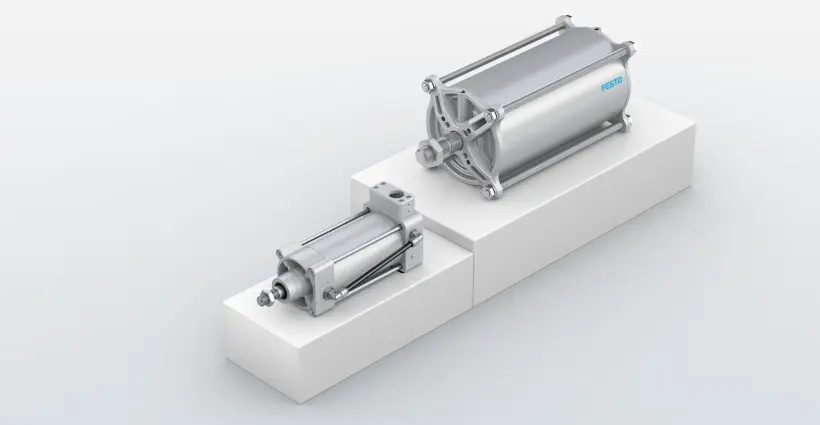
Beyond quarter-turn automation, many process tasks rely on accurate linear positioning, such as for regulating flow and fill levels or controlling air dampers. Our linear actuators with ISO 5210 and 15552 interfaces combine sturdy mechanics with configuration options for on/off tasks or closed-loop control via an integrated displacement encoder. With strong protection from external influences (IP65/IP67/IP69K) and ATEX-classes, you can assemble suitable process valves that are reliable in harsh operating conditions.
Valve positioners and feedback systems for process stability
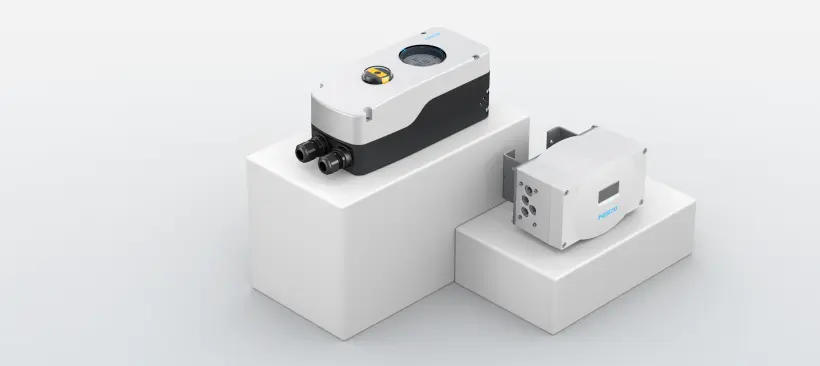
The CMSX and CMSH from Festo are reliable, high-precision positioners for linear and quarter-turn actuators, whether small or large, single- or double-acting.
CMSX is the economical choice for non-hazardous areas, providing defined fail-safe positions (open/close/hold) and pre-set emergency-stop behaviour to help reduce process risks.
CMSH is the versatile all-rounder with HART communication for fast, accurate control. Standardised interfaces, smart installation concepts, a clear plain-text display and built-in self-monitoring ensure dependable operation and enable quick status checks as well as straightforward commissioning.
Limit switches for reliable position detection and machine safety
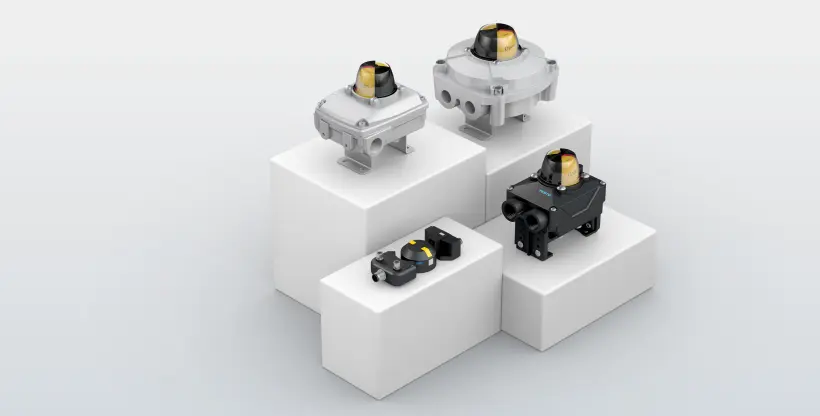
Limit switch boxes to VDI/VDE 3845 are used for electrical feedback and controlling the position of process valves actuated by pneumatic quarter turn actuators. No matter which sensor box you choose, they are all designed for quick and easy mounting to reduce installation effort. Our product range includes:
- Sturdy designs for harsh conditions
- Highly chemical-resistant versions
- Variants suitable for explosive atmospheres
- Compact solutions for tight installation spaces
Pilot valves for fast pneumatic control and efficient valve actuation
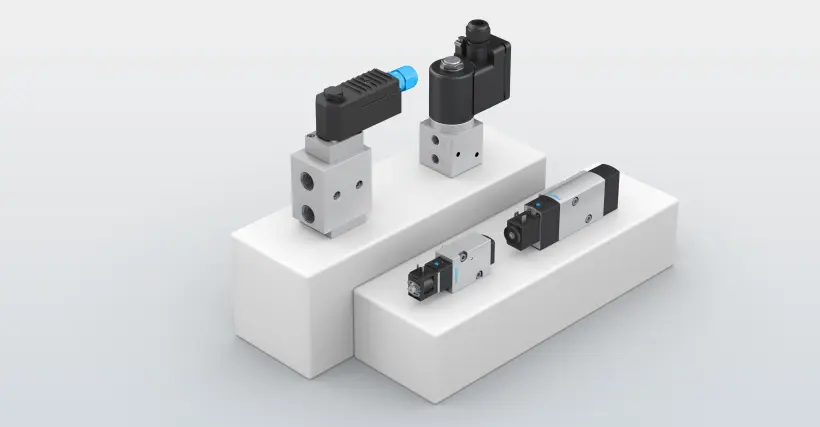
Our NAMUR pilot valves are ideal for single- and double-acting quarter turn and linear actuators. They are designed to automate and control process valves and actuators safely and reliably. Our product range includes:
- Solutions for single- and double-acting actuators
- Ex-approved versions for hazardous areas
- Variants that are extremely sturdy and corrosion resistant
- Variants for safety-oriented systems up to SIL 3
Accessories: tubing, fittings, mounting kits, and air preparation units
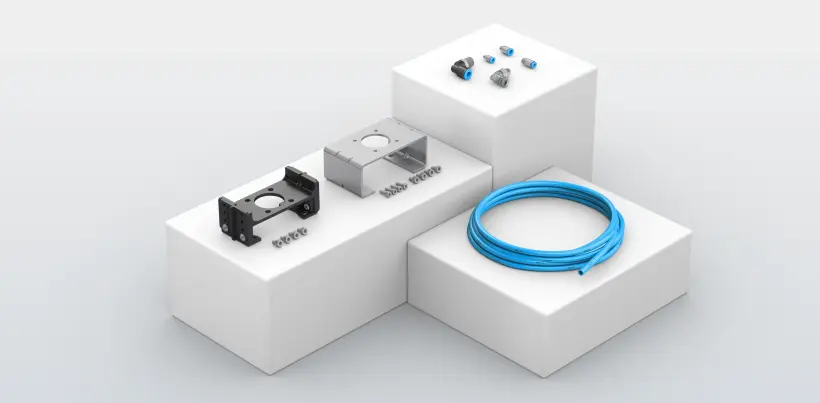
Our accessories are easy to install and optimise the pneumatic performance of components, while also boosting long-term system reliability. Correctly selected pneumatic accessories reduce leakages, stabilize pressure levels, and simplify assembly. These components are readily available in a range of different variants.
Your partner for process valve automation
The success of process valve automation depends on more than just individual parts; it takes a partner who understands complete systems, industry requirements and long-term operating performance to achieve high-quality designs. From engineering and commissioning support to lifecycle services, you will have everything you need to reduce complexity, improve reliability and protect performance over time.
Compliance and standards in valve automation
Ensuring products and solutions meet compliance requirements drives your delivery. Since each requirement comes with its own standards, you may need SIL for safety functions, ATEX-certified variants for hazardous zones, and the right solutions for hygiene-sensitive areas (for example product-contact vs splash zones). These topics often overlap, so the valve assembly must meet a combination of requirements.
Standardised interfaces and all-round compatibility
Integration challenges increase cost and are time-consuming. Standardised interfaces and accessories across the complete process automation portfolio help reduce integration work. Compatibility with multiple process valve manufacturers and industry-standard mounting support flexible design, reduce engineering effort and ensure systems are future-ready.
One-stop-shopping made easy:
- Valve to actuator: ISO 5211 for quarter-turn actuators; ISO 5210 and ISO 15552 where linear interfaces are used
- Actuator to pilot valve: NAMUR (VDI/VDE 3845) for consistent pneumatic control integration
- Actuator to positioner or limit switch: VDI/VDE 3845-1 and 3847-2 are widely used standards for sensor/feedback interfaces
- Accessories: providing a standard method for mounting a wide range of components
Engineering tools for faster and more reliable production selection
Our engineering tools are designed to make product selection easier and more efficient. They support you in choosing the right configuration for your application, from selecting the correct size and rotation angle to defining functions such as double-acting or single-acting operation. In addition, you can specify material options and surface treatments to ensure products perform optimally in your operating environment. This helps you quickly identify the right solution, reduce configuration errors, and streamline your engineering process.
Digital integration into process automation systems
Seamless data exchange with the highest control level is crucial. The positioner CMSH communicates directly with third-party control systems, enabling efficient data transfer and system transparency.
Components that are designed for Industry 4.0 and IoT environments can exchange information with the central control system, thus supporting advanced diagnostics and performance monitoring. When combined with solutions such as Festo AX for condition monitoring and predictive maintenance, this creates greater visibility, improves reliability, and optimises system performance throughout the entire lifecycle.
Global delivery, availability and lifecycle support
Automation projects rely on dependable supplies and consistent support. A global presence and strong regional supply networks allow you to access components and solutions worldwide. Services throughout the product lifecycle help you manage spare parts, plan for modernisations and make technical expertise available for the entire service life of your system, across sites and for future expansions.
Proven use in regulated industries
In regulated environments such as food and beverage, chemical processing, and water and wastewater, safety, reliability and compliance are non-negotiable. Our automation solutions for process valves are designed with a clear understanding of industry standards, operational pressures and long-term performance requirements.
FAQs
1. Which drive technology is suitable for the application: scotch yoke or rack and pinion?
This depends mainly on the torque curve, the installation space and the application. Scotch yoke actuators are especially suitable for applications requiring very high torques at specific positions of the swivel range, such as when opening or closing fittings. Rack-and-pinion drives, on the other hand, have an impressively compact design, a smoother torque curve and offer cost-efficient standard versions. The ultimate selection criteria are therefore determined by the required valve characteristics, the need for maintenance, space constraints and costs.
2. How do you correctly design forces and torques for the drive?
To create a reliable design it is not only the valve's nominal torque that should be taken into account, but also safety factors, starting and breakaway torques, holding torques, and possible emergency shutdowns. The medium itself together with the temperature and ambient conditions also affect the actual load. The aim is to design the drive so that it performs its function safely and reproducibly, even under real operating conditions.
3. What are the requirements for drives in hazardous areas?
In potentially explosive areas, drives must comply with the respective zones, ignition protection types, and temperature classes. This has a direct effect on the choice of materials, seals and suitable accessories. It is essential that both the individual drive and the complete solution meet all the relevant functional, environmental and safety requirements.
4. What is the role of a pilot valve in process valve automation?
The pilot valve controls the pneumatic operation of the actuator and thus carries out crucial functions such as switching, exhausting, and it can be used to implement fail-safe concepts. It also influences the reaction behaviour and the time needed to actuate the entire unit. It is thus an important link between the control system and the pneumatic drive.
5. How do you determine the appropriate flow rate for a pilot valve?
Selecting the flow rate depends on the time and force required for reliable actuation. In addition to the drive, the tubing lengths, any pressure losses, and the interaction with the other pneumatic components also play an important role. A suitable design helps to adjust switching behaviour, and it improves process reliability and energy consumption.
6. What must be considered when using pilot valves in explosion and safety-related applications?
In these applications, pilot valves must meet the requirements of the environment and the safety function. Relevant criteria include ignition protection type, temperature class, materials and corresponding certifications. Depending on the application, robust, corrosion-resistant or safety-related variants are also useful.
7. What are the main tasks of a positioner?
A positioner ensures that the valve position precisely follows the target position specification. To do this, it compares the target and actual value, compensates for friction or process deviations and ensures stable, accurate control. Modern devices also offer diagnostic functions that facilitate commissioning and operation.
8. Which communication interfaces are suitable for positioners?
The required interface depends on the automation architecture. Typical options are those with analogue signals, HART protocols or other bus systems for integration into higher-level controllers. The aspects of positioners that are particularly interesting for any application are: they support digital integration, improve system transparency, and facilitate data exchange, diagnostics, and parameterisation.
9. What are the benefits of positioners for diagnostics and operation?
In addition to providing precise control, positioners help to detect the condition of the drive/machine/system more quickly, simplify commissioning and make plant operation more transparent. Functions such as self-monitoring, plain-text displays, or diagnostic data support maintenance and troubleshooting. This reduces downtime risks and improves process stability over the entire life cycle.
10. What is the purpose of a limit switch box?
A limit switch box provides reliable electrical feedback on the end positions of an automated process valve. Depending on the version, it also has an easily visible position indicator which facilitates inspection, commissioning, and maintenance on site. It is the go-to solution for clear position feedback.
11. Which sensor technology is the right one for the limit switch box?
This depends on the operating environment and requirements. Different sensors have different features; for example, the service life, vibration resistance and suitability for hazardous areas will vary between reed switches, inductive sensors, and mechanical microswitches. The selection should therefore always be tailored to the specific application, the required robustness and the required signal type.
12. Which interfaces are important for limit switch boxes?
The most important factor to bear in mind is how the feedback will be integrated into the existing control landscape. Depending on the application, potential-free contacts, PNP/NPN signals, NAMUR sensors or other electrical interfaces can be considered. Standardised interfaces and installation options help reduce integration effort and enable easier connection between different valve manufacturers.
13. How are the interfaces between valve, actuator and accessories correctly defined?
To ensure they can be smoothly integrated, the mechanical and pneumatic interfaces should be specified according to the appropriate standard from the outset. Important standards include, for example, ISO 5211 for valves, as well as NAMUR and VDI/VDE interfaces for pilot valves, positioners, and sensors. This reduces compatibility risks and facilitates integration into multi-vendor projects.
14. What proof is required for combined solutions with ATEX or SIL?
Once several components are combined to form a process valve unit, the relevant requirements must be considered. Depending on the application, this includes proof of explosion protection, functional safety and the technical documentation for the overall solution. It is therefore not only the suitability of individual products that is important, but also how coherently all the components fit together and how well documented they are.
15. How does a configurator help you choose the right process valve solution?
A configurator simplifies the selection process by using a structured method to determine the most important parameters and then suggesting suitable solutions. This allows configurations to be created more quickly, order codes to be generated, and CAD data, documentation, prices, and delivery times to be retrieved. This reduces engineering effort, reduces integration and compatibility risks, and accelerates project execution.