Mondelez(亿滋)是食品行业的国际化大企业,旗下拥有 Côte d'Or(克特多金象巧克力)、Milka(妙卡)和 Oreo(奥利奥)等众多知名品牌。 公司的饼干和巧克力部门均在赫伦特尔斯设有工厂。 在该饼干工厂中,主要生产 Lu(露怡)饼干等产品。 Mondelez 巧克力部门则负责生产 Leo 饼干、Côte d'Or 巧克力条和复活节彩蛋。
他们的新项目 Ergomix 旨在为生产复活节彩蛋提供支持。复活节彩蛋的生产经常持续一整年,以确保复活节时有足够的存货,来满足人们对这种季节性产品的暴增需求。 该名称源于项目的初衷——改善操作人员作业时的人体工程学流程状态。 过去,需要人工按照蛋壳将不同口味的复活节彩蛋混合在一起,非常耗费人力。 现在,新开发的装置可全自动完成这项工作。
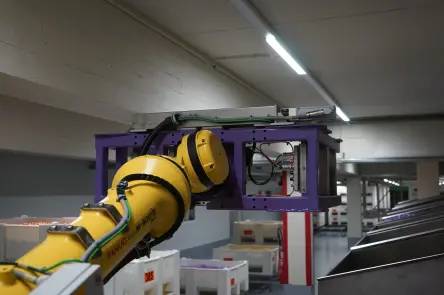
彩蛋离开成型生产线并完成单独包装后,便立即被输送带送至其下方的新装置中,然后先根据口味放在大型托盘箱中。 接着,由机器人准备进行混合,或由移动机器人拾取,暂时存放在储存站。 一旦生产混合口味型产品所需的所有口味均已就绪,便会通过漏斗将彩蛋运送到宽输送带上的特定位置,使所有口味在该输送带上相邻排开。 最后,将彩蛋放回托盘容器中,此时混合已经完成。
在驱动技术层面,第一大难题是,在将彩蛋装入托盘容器时必须放置整齐,不平整的表面会导致托盘无法堆叠。 第二大难题是,将漏斗定位在放有不同口味彩蛋的输送带上方,此时要求系统非常灵活,因为最终产品所包含的各种口味数量并不相同。 最后,必须为机器人的抓手配置合适的驱动,因为抓手必须移动 150 公斤重的托盘容器。
"Our initial thinking for this project was not to use pneumatics," says Bob Aerts from the technical department at Mondelez. "The idea was that electric drives perform better in terms of energy consumption, and it is also easier to implement all aspects of machinery safety. We presented this to Festo, and they not only understood our initial thoughts and the applications for which we wanted to build a system, but were also able to offer all the components that we needed to make it happen."
For Festo, the demand for electric drives is certainly not new. "We see this segment grow by more than 20% per year," says Johan De Pauw, Sales Engineer at Festo. "Certain applications are difficult or even impossible to implement using compressed air because of the speeds or the flexibility needed for positioning. With electric drives, there are far fewer restrictions in terms of design and production. In addition, the total cost of ownership for this application is lower with electric drives than with pneumatic ones."
Betecem was responsible for planning the system, with Koen Roobaert, Application Engineer at Festo, advising on the choice of components. Alax Automation was called in for the programming. "The collaboration went very smoothly," says Bob Aerts. "One of the advantages of Festo was that, right from the offer phase, all components were provided with links to all the documentation and files that could be used for engineering and sizing. This meant that everyone had the right information to get started right away.
In order to fill the pallet spaces evenly, a system was developed in which the conveyor belt that feeds the eggs can be moved to the left and right by two toothed belt shafts with a servo motor and torsion shaft. The conveyor belt can also be moved backwards and forwards using an electric cylinder with a ball screw in the extension area of the conveyor belt. This enables the system to position itself so that it can place the eggs anywhere on the pallet. The controller receives feedback from the load cells under the container and the flow rate of the feed so that it can determine exactly where there is still space in the container.
The funnels above the wide belt for mixing are also positioned using electric axes. This allows the positions to be automatically adjusted to the number of flavours that have to be combined in a particular mix. There is no longer a need for the system to be operated manually. The system is located in an air-conditioned room in the basement and operates fully automatically. The robot gripper, which moves the pallet boxes, was also equipped with an electric cylinder ESBF with a servo motor. All servo motor controllers CMMT are located in a control cabinet outside the air-conditioned room. These communicate with the PLC that controls the system via PROFINET.
The new system has now been in use for some time and the electric drives have already proved their worth. It took a long time, for example, to find the right parameters and achieve the optimum result for filling the pallet boxes evenly. The advantage of electric drives is that you can easily adjust the speeds and positions via the software. Changing the line on which the mixes are produced is also done entirely by the software.
"Another advantage of Festo was that they offer a complete range of components," says Bob Aerts. "This includes not only the mechanical drives, gear units, motors and actuators, but also all the necessary mechanical process valves and accessories. This has helped us enormously with standardisation and also ensures that all components are perfectly matched. We would not have been able to achieve the flexibility that we now have with this system using pneumatic drives."